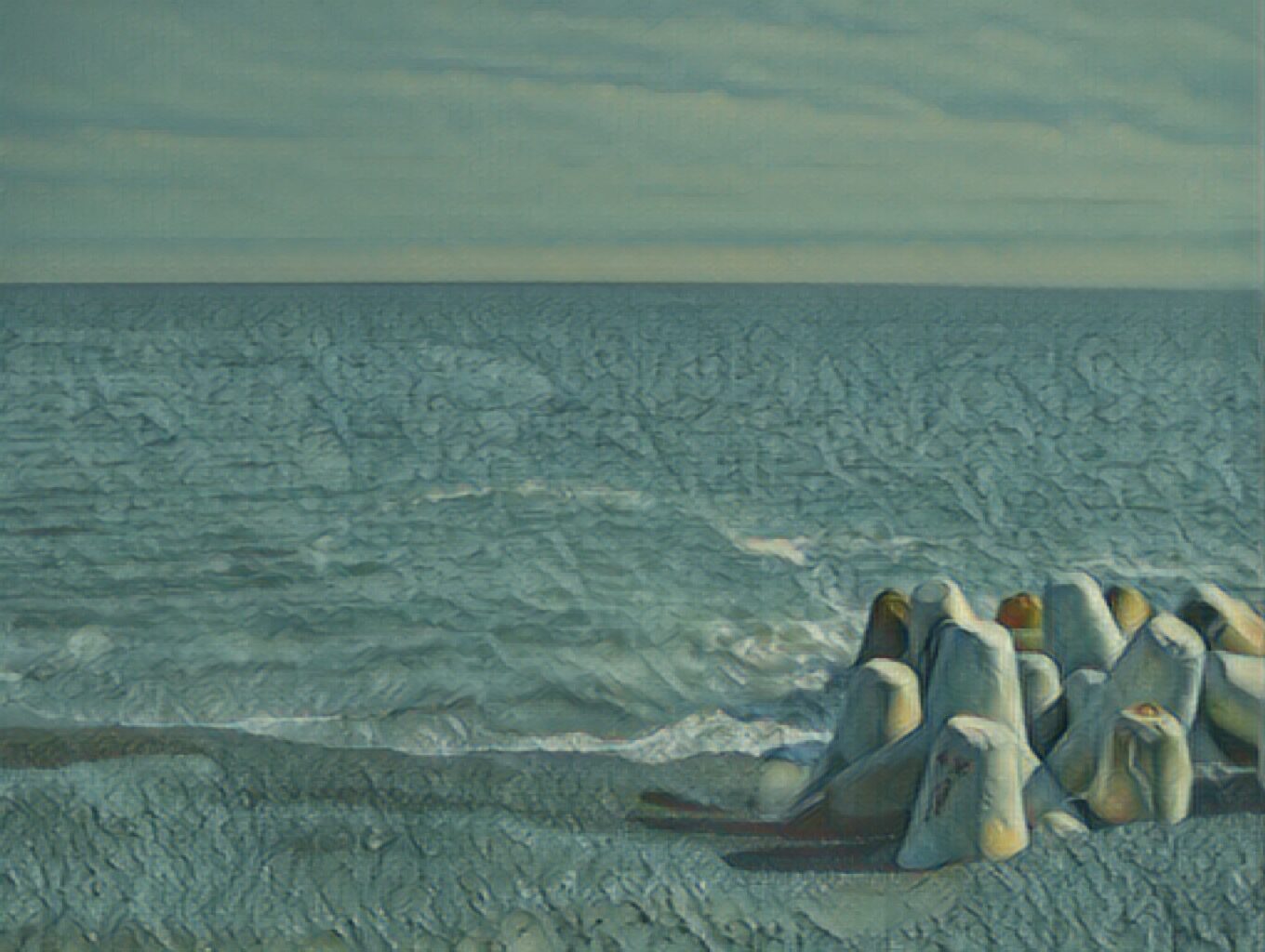
Just as a computer operates through the potential difference between 0 and 1, perhaps this world, too, is established through a similar dynamic of binary potentials. The reason we are able to move within this world—with our movements interrelating while each maintains its own form under a certain order—may be that we are repeating cycles of “unfilled positive (+)” moments and “filled negative (-)” moments.
In the unfilled (+) moment, there is a “void” (margin) that allows for movement precisely because it is not full. Conversely, in the filled (-) moment, there is no void in which to move; thus, we are unable to move at that instant, yet we are able to preserve our respective forms. Is it not possible that such a repetition constitutes our existence? From this perspective, one can view the world as a sequence of (-) moments where something is added and (+) moments where something is lost. Perhaps our daily activities consist of these movable (+) moments, while in the intervals between them lie the (-) moments that remain unobservable to us in our everyday lives.
(Note: I have written that when a void is created through some deficiency, everything begins to move toward it, meaning that each movement is interrelated and thus possesses order. While I compared this to the potential difference in a computer, I do not necessarily imply that it is bound by a fixed rhythm or pattern.)
If there are (-) moments where something is added and satisfied, and (+) moments where a void is created through loss—and if this void enables all movement, with every motion relating to and finding order by aiming for that void—then it would seem a prerequisite that the “filled space” be a closed system. However, if we instead define the (-) and (+) moments simply as “moments without void” and “moments with void,” then we can conceive that a (+) moment arises around any (-) moment, and another (-) moment arises around that. In this view, there is no need to consider where the boundaries of space lie. While this description might risk the misunderstanding that there is a central point in space, that too is something that need not be considered. One can simply think of it as a gradation of density between these (-) and (+) moments.