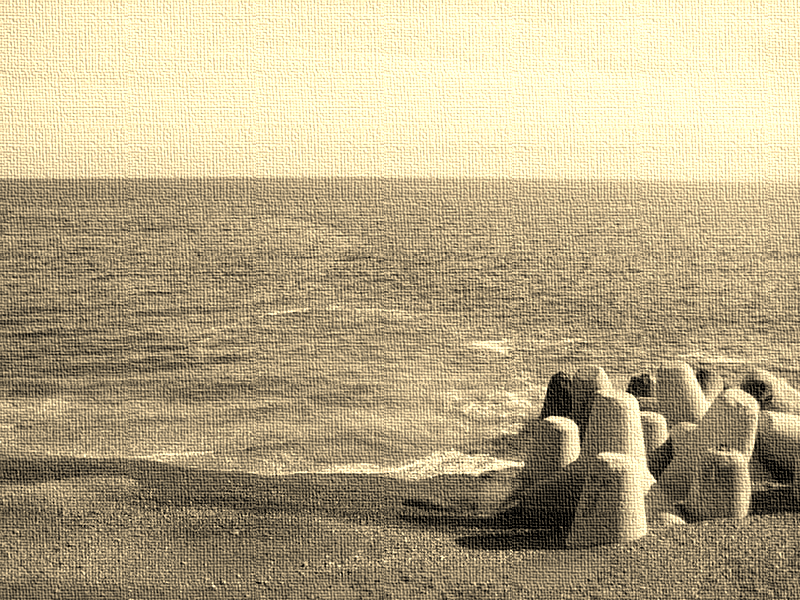
At that moment, I should have been looking forward. Yet, in all likelihood, what my eyes were capturing was the view behind me. The only thing remaining in my hands to tell the tale of that experience was a book containing a single illustration.
I had found the book at Bungaku Flea Market—an event where authors hand-deliver their own works to readers. As long as the author believes their work to be “literature,” practically anything is permitted.
A few days ago, I visited this event held at Tokyo Big Sight. Officially known as the Tokyo International Exhibition Center, it is an architectural marvel capable of hosting all manner of exhibitions. With its four inverted pyramids supporting conference rooms that appear to float in mid-air, the structure unnerves the perspective of anyone looking up from the ground. It seemed to symbolize the experience I was about to encounter.
It was my first time visiting both Tokyo Big Sight and the Bungaku Flea Market. Having taken the wrong train, I arrived with only thirty minutes left before closing. The venue was immense; seeing everything in thirty minutes was an impossible feat. I scanned the area, hoping to find genres that interested me. That was when I noticed something.
As I looked around the booths, they were indeed categorized by genre. However, there were no signs or displays indicating the sections. You had to walk through them to understand the layout. It was truly the embodiment of a “flea market.” People gathered as they pleased, freely selling what they wished to sell. I had heard that the Bungaku Flea Market was established as a counter-movement against the vested interests of Japan’s major publishing industry, and this atmosphere was perhaps a direct reflection of that spirit.
I drifted through the booths as quickly as possible. Then, a booth situated at the very end of a row caught my eye. While many participants decorated their stalls elaborately to showcase their works, this one was exceptionally modest, tended only by a single elderly man.
“Young man, are you looking for something?” The old man seemed to notice my gaze.
Asked this, I momentarily forgot why I was even there. As I hesitated, he continued.
“Why don’t you try reading this? It might just transform your vision.”
I accepted the book he handed me and opened it.
“This is—?” I gasped.
Nothing was written inside. It was blank. I instinctively recoiled, nearly stumbling backward. In that instant, I gasped again. Both the old man and his booth had vanished. In their place was an entirely different stall, where a young man was staring at me suspiciously.
“Would you like to take a look?” the young man asked, observing my confusion.
I looked down at the book in my hands. The blank book. It was definitely there. It wasn’t a dream. I opened it again; still, there was nothing. When I looked up to ask the young man about the elder, I cried out in surprise.
The old man and his booth had reappeared right before my eyes.
“Why? How is this happening?”
The old man smiled and said to me, “Take a look behind you.”
I turned around, and there was the young man from a moment ago, looking at me with a puzzled expression.
“What does this mean? How?” I asked the old man, trembling. I had no memory of moving a single step. The old man replied:
“That is what a book is—what literature is. What you thought was in front of you appears behind, and what you thought was behind appears in front. Don’t you agree?”
I didn’t know how to respond. It felt like a trick. The book itself was empty. I jerked the book open once more and stood aghast. There, an illustration of the old man waving his hand had appeared. I immediately looked up. The old man’s booth had vanished into thin air. I searched the entire venue, but I never found that booth again.